

Last updated on June 15th, 2023
In this next installment of our F-Tag food safety series, we’re going to dive into tag F-803. This tag focuses on menus and nutritional adequacy. It states that menus at your senior living community must:
- Meet the nutritional needs of residents in accordance with established national guidelines
- Be prepared in advance
- Be followed
- Reflect, based on your reasonable efforts, the religious, cultural, and ethnic needs of the resident population, as well as input received from residents and resident groups
- Be updated periodically
- Be reviewed by the facility’s dietitian or other clinically qualified nutrition professional for nutritional adequacy
- Not limit the resident’s right to make personal dietary choices.
Because December is Worldwide Food Service Safety Month, we wanted to take some time to explain more about what food inspectors are looking for when they’re evaluating compliance with the F-803 tag.
What is the Purpose of the F-803 Tag?
This tag intends to assure that your community’s menus are developed and prepared to satisfy resident choices (like their nutritional, religious, cultural, and ethnic needs) while following established national guidelines.
This means that your community’s dining program needs to provide choices that are resident-specific. Menus must be sensitive to the wants, desires, and backgrounds of the people you serve. They also need to be nutritious and follow the guidelines of each resident’s prescribed diet.
Inspectors want to see that you’re making reasonable and good faith efforts to develop a menu based on resident requests and group feedback. This doesn’t mean that you need to create an individual menu for every resident for every meal. It means you need to attempt to provide food that is appetizing to and culturally appropriate for residents. You must learn resident needs and preferences, and then provide menu alternatives that align with them.
And you need to be able to prove you’re doing this. If during a meal observation, an inspector finds that a resident’s meal options are inadequate, they’ll use interviews and a record review to see if your staff made reasonable efforts to review and/or adjust the menu to meet the nutritional, religious, cultural, ethnic needs, and preferences of the resident.
In communities that Culinary Services Group works with, we use meal rounds, resident satisfaction cards, routine and periodic preference reviews, food committees, and dining room kiosks as tools to track and react to residents’ food preferences.
What Else Are Food Inspectors Looking For?
So how do food inspectors evaluate compliance with this tag? They’re looking for:
- Residents receiving food in the amount, type, consistency, and frequency to maintain normal body weight and acceptable nutritional values.
- Resident preferences and needs are incorporated into the development of the individual food plan.
- If a resident chooses not to consume certain foods or food groups (like if the resident is vegetarian), how does the facility ensure the resident’s menu and/or the individual resident’s food plan meets his or her nutritional needs?
- Menus meet basic nutritional needs by providing meals based on individual nutritional assessment, the individualized plan of care, and established national guidelines and are periodically updated to mitigate the risk of menu fatigue.
- Menus are reviewed and revised as needed by a qualified dietitian or other qualified nutrition professional.
How Can You Ensure You’re Complying With the F-803 Tag?
Some common examples of non-compliance with this tag include not having inventory on hand for three or more days, incorrect textures per resident diet order or care plan, resident preferences not being up-to-date, a variety of options not being available, and substitute food items aren’t being approved by a nutrition professional or logged.
But you can avoid these common blunders by following a few simple procedures.
Use Prep/Pull Sheets
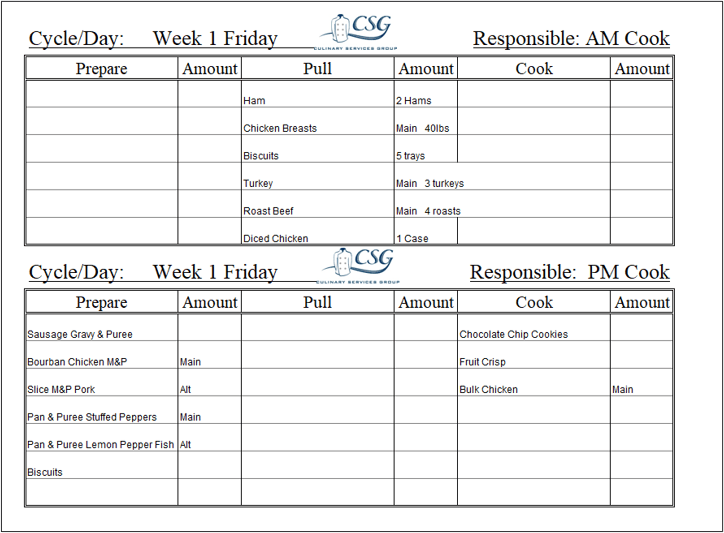
Prep/pull sheets help you get organized by documenting what each day’s meals will be along with their alternate items. This not only helps your chefs in the kitchen but provides records of compliance for food inspectors.
Substitution Logs
Substitution logs help you verify and document that all food substitutions are approved. When one of your menu items needs to be substituted with another, add it to the substitution log and have your registered dietitian review it and sign the log to confirm their approval. A well-balanced cycle menu is designed to ensure key nutrients fall within a certain range based on a therapeutic diet. Based on a therapeutic diet, some residents may not be able to have the substitute, so it’s important to check with the nutrition professional to ensure substitutions are safe for everyone.
Post Menus and Communicate Menu Changes
Make sure each week’s menu is posted in your community and that any changes are well-communicated to residents. Don’t just rely on word-of-mouth to spread the news about menu changes – have a policy in place so that everyone in the building is aware and agrees to the process and plan of action. Basic documentation for planning and communication of special meals, substitutions, and planned cycle changes should be part of the policy since surveyors will want to see proof of the policy in action.
Get Resident Feedback
Even if there weren’t food inspectors to report to, you should still be getting resident feedback on your menus. One way we like to do this is through food committee meetings. This is where your dining team finds out what food your residents want to be served in a group setting. Ask residents what they like and don’t like for breakfast, lunch, dinner, snacks, and beverages. Two of our favorite open-ended questions to ask during food committee meetings include “Are there any items not on the menu that you would like to see on the menu?” and “Are there any items you receive daily that you don’t eat?”.
During the COVID-19 pandemic, it may be difficult to get all your residents and staff together for a meeting to find out their preferences. But that doesn’t mean you’re out of luck. Instead, include cards on each resident’s individual tray to collect feedback. Ask them how they feel about the current meal they’re eating and ask what they would like to see more or less of in the future.
If this sounds like a lot to keep track of, don’t worry. The Culinary Services Group team can help ensure you’re passing your food safety inspections while providing delicious meals to your residents. We take great pride in operating safe, clean kitchens, and we can’t deliver on our promise of delicious, healthy food if your kitchen doesn’t pass state health inspections first.
We take our commitment to safety so seriously that if you sign a contract with us and receive a moderate to a serious violation that requires another inspection, we’ll forgo our management fees until the problem is resolved and your facility passes inspection.
If you’d like to learn more about how we can help your dining team stay compliant with the F-803 tag, contact us here.